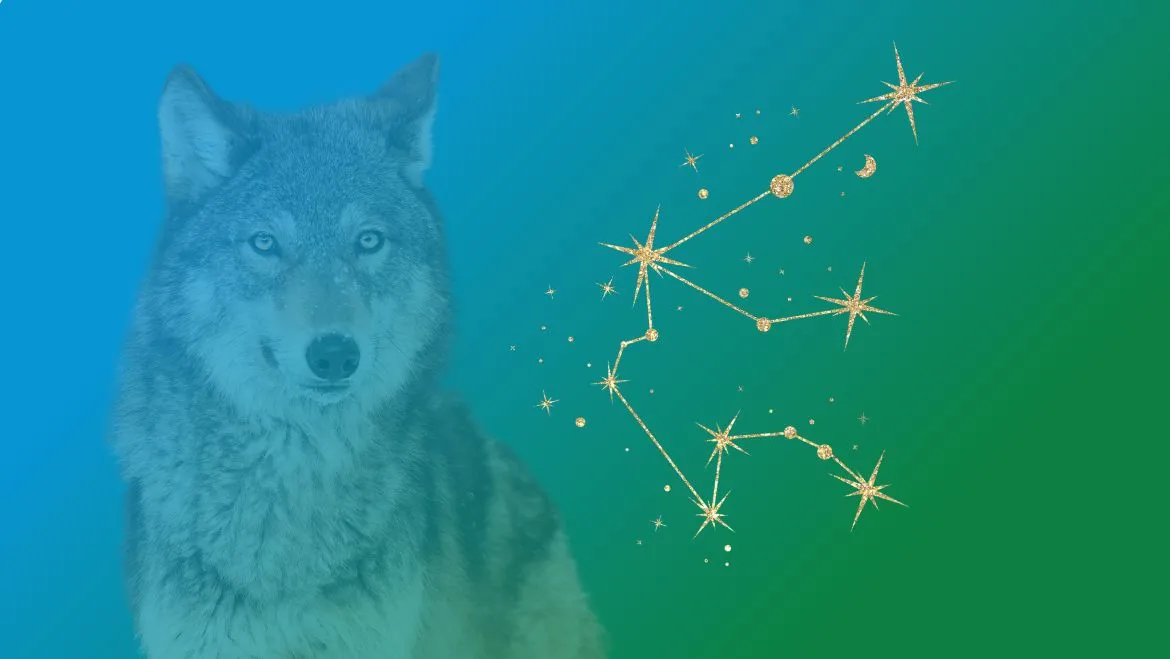
When people with strong Aquarian energy journey to meet their animal, the wolf almost never comes bounding up to them. It stops at a distance — usually just at the edge of where they can still see it clearly — and it looks at them. Not with hostility. With assessment. And the thing people report most often afterwards is that they felt judged and, at the same time, entirely welcome. That contradiction is not a flaw in the vision. It is the animal itself.
This page is about what the Aquarius spirit animal actually means — not the star chart, not the horoscope column. The wolf is the animal of this sign because it holds a contradiction that Aquarians live inside every day: total belonging and non-negotiable freedom, in the same body, at the same time. Most people try to resolve that tension. The wolf does not. It just lives it.
The Biology That Makes the Wolf the Aquarius Spirit Animal
Start with a correction, because the popular version of the wolf is wrong in a way that matters enormously here.
There is no “alpha wolf” in the wild in the sense most people mean. The dominance-hierarchy model came from studying unrelated wolves forced together in captivity — a group under stress, behaving in ways wild wolves do not. In the wild, a wolf pack is a family. The leading pair are the parents. The others are their offspring. Nobody is fighting for a throne; they are raising young, hunting together, and — crucially — leaving. Young wolves disperse. They walk away from the pack, sometimes hundreds of kilometres, alone, to find territory and a mate of their own. And they are not exiles. Dispersal is normal, expected, structural. The pack does not break when a wolf leaves it.
That is the bridge, and it is the whole article in one sentence: the wolf’s freedom is not a rebellion against its belonging. It is a feature of it. Aquarian energy is chronically misdiagnosed as aloofness or detachment, usually by people who have taken the leaving personally. But the wolf that disperses is not rejecting the family. It is doing exactly what a healthy member of that family does at that stage of life — and the pack it eventually founds is the reason the species survives at all.
Add one more fact. Wolves hunt animals many times their size, and they do it not through strength but through coordinated intelligence and endurance — testing the herd, reading which animal is weak, working in relay over distances that would exhaust anything else. The wolf wins by seeing the system. This is why the wolf and the Aquarian mind fit so exactly: both are pattern-readers, both prefer the long game, and both are more dangerous when they are patient than when they are angry.
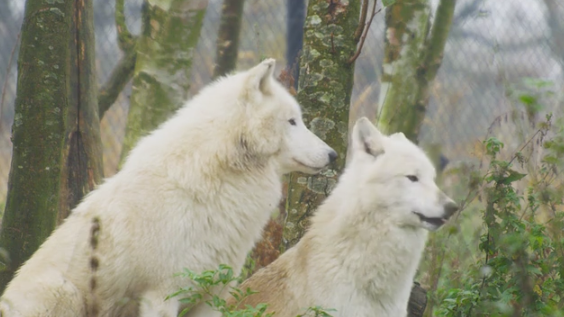
Wolf Symbolism and the Water Bearer
The wolf is one of the most heavily mythologised animals on earth, and the traditions do not agree with one another. That disagreement is useful.
In Norse material, the wolf is genuinely double. Fenrir is the bound wolf who will break free and end the world — the force the gods feared enough to deceive. But Odin, the god of knowledge, keeps two wolves at his side, Geri and Freki, and feeds them from his own table. The same animal is both the thing that terrifies the established order and the companion of the one who seeks wisdom. Any Aquarian who has been called “too much” by one person and “visionary” by another will recognise the arrangement.
In Roman foundation myth the she-wolf suckles Romulus and Remus — the wolf as the one who raises what society abandoned. In Mongolian tradition the blue-grey wolf stands at the origin of the people. And in a number of Indigenous North American nations — among them the Anishinaabe, where Ma’iingan the wolf is understood as a brother to the first human, sharing a fate — the wolf is a teacher of kinship and of the consequences of breaking it. I name these traditions specifically rather than saying “Native American,” because they are distinct peoples with distinct stories, and precision is the least the material is owed.
The consistent thread across all of them: the wolf is the animal of the bond that is chosen rather than assumed. Wolves are loyal, but the loyalty is not compulsory, and that is precisely what makes it worth something. This is the water-bearer’s medicine too — the Aquarian pours out water for everyone, but you cannot make the water come.
The Shadow Side of the Aquarius Wolf
This is where most zodiac writing stops, and it is where the useful part begins.
The lone wolf that is actually a wounded one. The most common Aquarian distortion I encounter is a person who has made independence into a doctrine — and who cannot remember the moment they decided that needing people was dangerous. In wildlife biology, a wolf that lives alone long-term is usually not a hero. It is a wolf that lost its pack, and a lone wolf’s life is measurably harder and shorter. If you have been proud of not needing anyone for a very long time, ask when the pride started. There is almost always a date.
Loving humanity, avoiding the human. Aquarian energy can care intensely about the collective and remain almost unreachable to the specific person in the room. It is easier to fight for a cause than to be known by a partner. The wolf’s shadow here is not coldness; it is displacement — the pack you defend is theoretical, and the family that actually needs you is not being fed.
The vision that outruns the ground. The wolf that keeps testing the herd but never commits to the chase will starve. There is an Aquarian pattern of endless conceptual circling — always the better idea, always the next system, never the exhausting, unglamorous run.
When the wolf turns. If a wolf appears in a recurring nightmare, hunting you, or if you dream of a wolf that is caged, chained, or muzzled, it is worth sitting with carefully. In my experience the pursuing wolf is not an outside threat. It is your own instinct, arriving as a predator because you have been treating it as one for years — the anger, the appetite, the refusal you would not let yourself feel. And the chained wolf is the same energy from the other side: the part of you that knows exactly what it wants and has been kept on a leash because someone, long ago, made it clear that wanting was not safe. Fenrir was bound by deception, and he did not stay bound. Neither will this.
A Journey to Meet the Wolf
Here is the practice I give people working with this animal. Allow twenty-five minutes, and do it on a day you are not trying to be impressive.
- Prepare a container. Dark room, blanket, a steady drumbeat for fifteen to twenty minutes. Lie down. Cover your eyes.
- Set an intention the wolf can actually answer. Not “show me my purpose.” Ask: “Where have I confused freedom with distance?” Say it aloud once.
- Travel to a treeline at night. Winter, snow, open ground behind you and forest ahead. Stand at the edge. Do not enter.
- Wait to be assessed. The wolf will come to the edge of your vision and stop. Do not approach it and do not call it. Let it decide. This is the part people find hardest, and it is not accidental — the whole medicine of this animal is that the bond must be freely given.
- Ask to see the pack. When it moves, follow. Ask it to show you your pack — the actual one, not the one you tell people about. Notice who is there. Notice who is missing, and whether you removed them.
- Ask the leaving question. Before you return, ask: “What am I meant to disperse from — and what am I meant to return to?” The wolf answers this one more clearly than any other.
- Thank it and come back at the callback beat. Write everything down before you talk to anyone.
The integration: within the next week, ask one person for something. Something small and real that you would normally handle alone. Notice the resistance in your body when you do it. That resistance is the wolf’s shadow, and it will tell you more in ten seconds than a month of reading will.
If you want to go further with this animal on its own terms, the wolf spirit animal guide goes deeper into its medicine, the A–Z of spirit animals will help you check whether the wolf is really the one walking with you, and the Path of the Paws oracle deck was built for exactly this kind of enquiry.
Aquarius Spirit Animal: Questions People Actually Ask
What is the spirit animal for Aquarius?
The wolf. Not because Aquarians are “lone wolves” — that phrase gets the animal exactly backwards — but because the wolf holds the same contradiction the sign does: deep, structural loyalty to the pack, combined with a normal, healthy drive to leave it and build something new. The wolf does not experience those two things as a conflict, and neither, at its best, does Aquarius.
What does it mean when a wolf appears in my dreams?
A wolf that walks beside you or watches you calmly usually points to instinct that is available to you and has not been used. A wolf that hunts you is, in my experience, almost never an external threat — it is your own suppressed appetite or anger arriving as a predator because that is how you have been treating it. A caged or chained wolf points to a want you have kept on a leash for a very long time.
Can an Aquarius have a different spirit animal?
Yes, and many do. A birth sign is a doorway into an animal, not an assignment of one. The wolf is the animal that mirrors Aquarian structure most exactly — but the guide that actually comes when you journey is chosen by something other than your birth date, and it is frequently a surprise.
Is the wolf a good or a bad omen?
Neither. The traditions themselves cannot agree — Norse myth gives us both Fenrir, who ends the world, and Odin’s wolves, who sit at the table of wisdom. The wolf does not predict outcomes. It diagnoses your relationship to instinct, to belonging, and to your own freedom — and then it waits to see what you do about it.
The wolf does not choose between the pack and the wilderness. It carries both, and it is never asked to explain itself. That is not a personality type. It is an instruction — and for anyone who has spent years apologising for needing both, it is a very old permission.