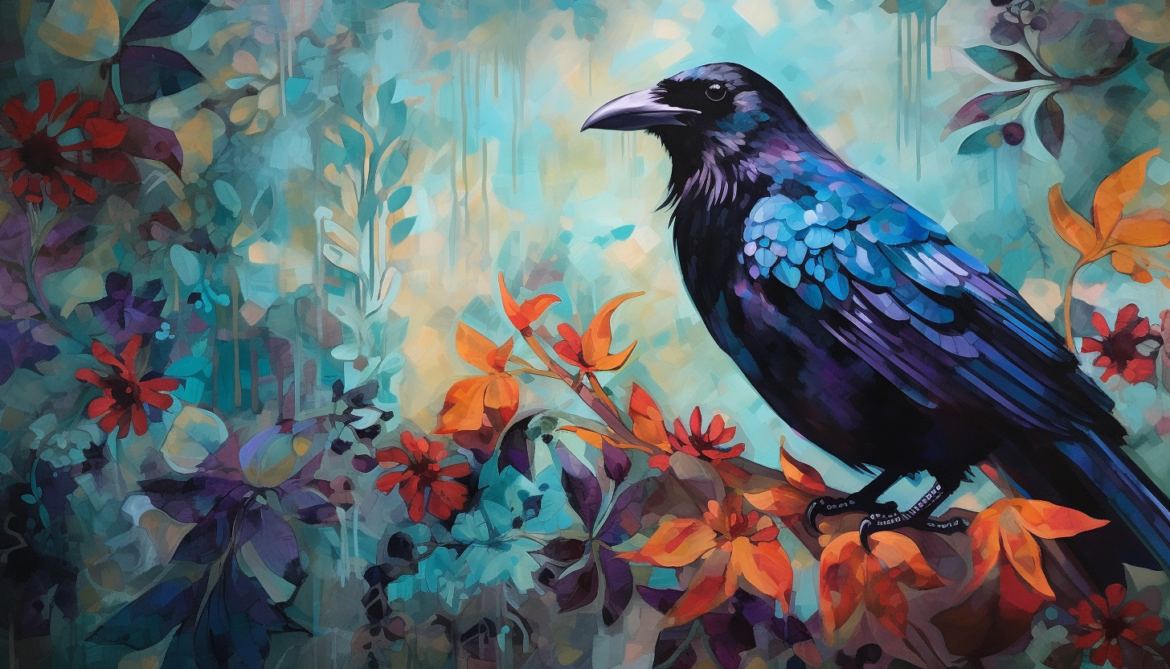
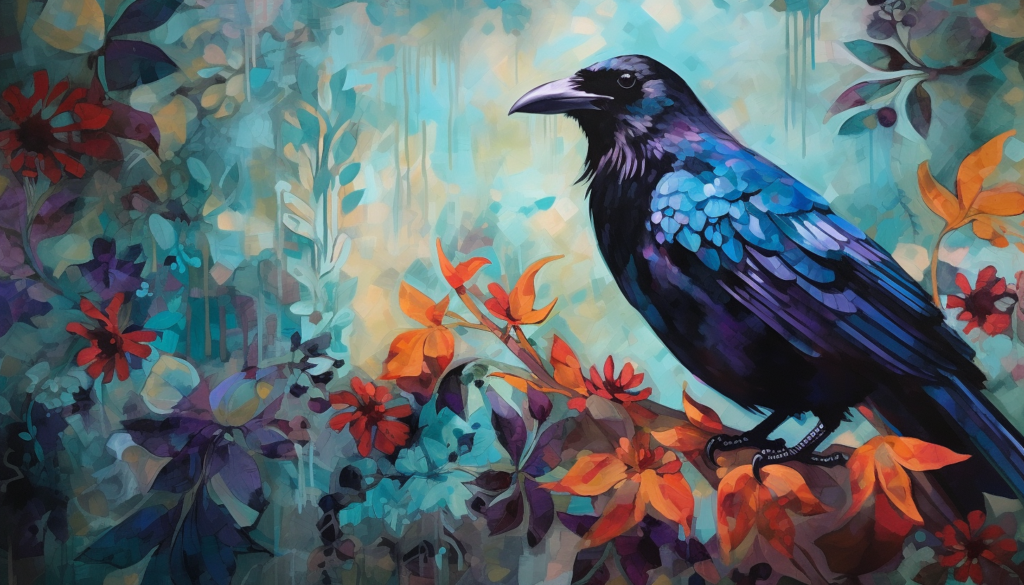
Crow does not announce herself with drama. She arrives as a change in the quality of your attention — a sudden sharpening, as if someone had turned up the contrast on the world. On the journey where she first came to me, I was practising remote viewing and tracking, and I felt a weight land on my left shoulder before I saw anything at all: the small, deliberate grip of claws, the tilt of a head, an eye like polished obsidian looking straight through my intention to the thing underneath it. That is the physical signature of the Crow spirit animal in my experience — a prickling alertness at the back of the neck, and the unnerving sense of being read.
Gently, it perched on my shoulder, full of curiosity. I knew right away how intelligent this bird was. And it turned out to be an amazing tracker.
In over twenty years of shamanic and coaching practice, I have learned to take Crow’s arrival as an instruction rather than a comfort. She comes when something is hidden — usually something you half-know already — and she will not leave until you look at it.
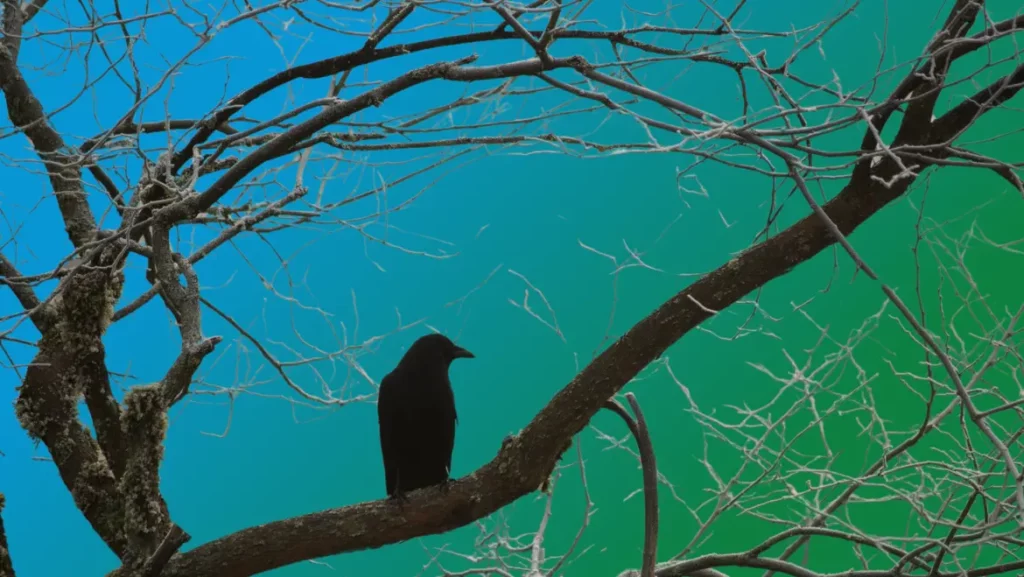
From Corvid Biology to Crow Medicine: Why This Bird Carries This Message
Crow’s symbolism is not arbitrary. It is drawn, almost line for line, from what the living bird actually does.
- She recognises faces — and remembers. Research at the University of Washington famously showed that wild crows recognise individual human faces, hold a grudge for years, and pass that information to birds who were never present. Crow medicine is the medicine of memory and consequence: what you do is noticed, and it travels.
- She makes tools. Corvids bend wire into hooks and solve multi-step puzzles. This is why Crow appears when you need lateral intelligence, not more effort — the answer is a different approach, not a harder push.
- She lives on the edges. Crows thrive at the boundary between wilderness and settlement, field and city, life and carrion. An animal that feeds where things end is naturally the animal of thresholds — hence her long association with death, transition and the space between worlds.
- She holds funerals. Crows gather around their dead, loudly, and study the scene. They are not mourning as we do — they are learning what killed one of them. That is Crow’s gift precisely: look directly at the loss and extract the information.
If you see or hear a crow repeatedly, it may be seeking you as a totem animal. In any case it is usually a sign that you should pay very close attention — and with her intelligence and precise senses, she is offering to help you do exactly that.
Comprehensive Shamanism Online Training
Join our empowering shamanism training series, “The Elements of Shamanism,” to learn shamanic practices through the lens of the elements: Water, Earth, Fire, and Wind. This course is perfect for anyone who wants to start their shamanic path to improve their own life. Through the online classes, you will learn key skills like shamanic journeying, connecting with spirit animals, and exploring your ancestral lineage.
“The Elements of Shamanism” is a course that invites you to embrace your personal power with some of the most important techniques of shamanism.
Core Symbolism & Historical Context: Crow Across Traditions
Norse: The Mind and the Memory
In Norse mythology Odin keeps two corvids, Huginn (thought) and Muninn (memory), who fly out over the world each morning and return to whisper what they have seen. Odin says he fears more for Muninn’s return than Huginn’s — he fears losing memory more than losing thought. Sit with that. Crow’s counsel is that what you refuse to remember is more dangerous than what you fail to figure out.
Celtic: The Morrígan and the Battlefield
In Irish tradition the Morrígan appears in crow and raven form over the battlefield — not as a bringer of death but as the one who sees it coming and speaks it aloud. In Celtic mythology more broadly the crow is a symbol of the supernatural and of the permeable border between worlds. Crow is the truth-teller nobody wants to hear, and she is usually right.
Pacific Northwest: The Bringer of Light
Among peoples of the Pacific Northwest coast, Raven and Crow are the trickster-creators who steal the sun and release light into a dark world. These are living traditions belonging to specific nations, and I reference them here with respect rather than any claim to their ceremonies. What the archetype offers universally is this: the one who breaks the rules is often the one who brings the light.
Witchcraft and the Familiar
Historically, crows were tied to witches in European folklore — witches were said to shapeshift into crows or keep them as familiars. This says less about crows than about us: the crow was demonised for the same qualities we now prize in her — intelligence, independence, and an unsettling refusal to be sentimental. In practices of divination and spirit contact she is the classic bridge between the material and spiritual worlds, carrying messages and guarding what is hidden.
Characteristics of the Crow as a Power Animal
The symbolism of a spirit animal is always personal. Still, in my practice these four qualities appear again and again when Crow steps forward:
- Lateral intelligence: the willingness to drop a strategy that is not working and try a different shape of solution. Crow does not push harder. She goes round.
- Guardianship of thresholds: she is steady in endings, including bereavement, because endings are her habitat rather than her emergency.
- Honest memory: she keeps the record. Her medicine is not forgetting, and it is not brooding either. It is taking the information out of the injury and then putting the injury down.
- Experiment over ritual: Crow rewards people who test things and loses interest in people who repeat things.
She is a genuinely powerful guide for inner growth — but she is not a gentle one. When you connect with the Crow power animal, you gain her clarity, and clarity always costs something.

The Shadow Aspect: Crow’s Warning Medicine
Crow has a difficult side, and pretending otherwise is bad practice. Here is what I actually look for when a client brings me a troubling crow encounter.
- Intelligence weaponised. Crow’s shadow is the mind used as a shield: cleverness deployed to avoid feeling. If you can explain your grief beautifully but cannot cry, Crow is not your ally — she is your accomplice. Ask whether your insight is serving your healing or replacing it.
- The unpaid debt of memory. Crows remember. Crow’s shadow is the grudge you have not put down — the story you rehearse, the injustice you keep polished. Her medicine turns corrosive when memory becomes a place to live rather than a source of information.
- The recurring crow nightmare. Crows massing, screaming, pecking, or blocking a doorway is one of the most common “dark” spirit animal dreams people bring me. It is almost never an omen of death. In the great majority of cases it is a truth demanding to be spoken — something you know about your marriage, your work, your family that you have decided not to know. The birds get louder the longer you refuse.
- Crow turned away or silent. When she appears on a journey and will not speak, I read it, in my practice, as a warning against premature interpretation: stop trying to decode, and go back and look at what actually happened.
A necessary caution: if a recurring nightmare is disturbing your sleep, mood or daily functioning, please treat that seriously and speak with a qualified doctor or therapist. Shamanic work sits alongside good psychological care — never instead of it.
Practical Shamanic Work with the Crow
I always recommend journeying to the lower or upper world and asking the spirit animal that came to you for more information directly. If you do not journey yet, our training The Elements of Shamanism is a solid starting point — or begin with the beginner’s guide to shamanic journeying.
The Tracking Journey: Finding What Is Hidden
This is the Crow journey I use with clients when something is obscured — a decision, a lost part of the self, a situation they cannot read.
- Frame the question as a search, not a wish. Crow tracks. Give her something to find: “Show me what I am not letting myself see about ______.”
- Set the container. Darkened room, 15–20 minutes of steady drumming, eyes covered, phone off.
- Go up, not down. For Crow I usually journey to the upper world — climb a tree, a rope of smoke, a mountain path — and pass through a membrane at the top.
- Let her lead from above. Ask her to fly and follow the view she gives you. Crow shows you a landscape, not a lecture: notice what is behind the thing you were looking at.
- Take the object she offers. Crows bring gifts to people who feed them. If she drops something at your feet, take it and ask what it is for.
- Return, and write it raw. Record the images before you interpret them. The meaning usually arrives two days later, unbidden.
The Reciprocity Ritual
Crow’s relationships are transactional in the healthiest sense: she gives to those who give. To build an ongoing relationship:
- Make a real offering. Unsalted nuts or seeds on a windowsill or in a garden, at the same time each day. Do it consistently or not at all.
- Speak one hidden truth aloud each week — to yourself, out loud, in a room alone. This is the core of Crow practice.
- Keep a “black feather” page in your journal: one line per day recording something you noticed but would rather not have noticed.
- Close the loop. When an insight proves true, say thank you out loud. Reciprocity is what turns a visitation into a relationship.
The Gift Exchange: What Crow Does When You Keep Your Side
There is a well reported case from Seattle in 2015. A young girl named Gabi Mann had been putting out food for the crows in her garden every day, and the crows began leaving things behind on the empty tray: beads, a button, a screw, small pieces of polished glass. Once, reportedly, a lens cap her mother had dropped in the street. Ornithologists were careful about what could be concluded from a single household, and the caution was right. What is not in dispute is the capacity behind it. These birds know individual human faces, hold that knowledge for years, and share it.
I keep coming back to that story because it describes the shape of the relationship exactly. Crow does not respond to admiration. She responds to a pattern kept up over time by someone she can identify. Nothing about that is mystical, and that is what makes it useful: it is the same standard she applies on the inner journey. Turn up daily, tell the truth in the same place at the same hour, and eventually something is left on the tray.
The inverse holds too, and it is the part people skip. A crow that has been treated badly remembers the face, and so do birds that were never there. In practice this means Crow is a poor guide for anyone hoping to work on themselves in secret while behaving carelessly in the rest of their life. She has one standard for both.
Crow Spirit Animal: Questions People Actually Ask
Is seeing a crow a bad omen?
No, and the belief is worth examining rather than simply refuted. Crows feed at the edges of things, including at carrion, so people who lived close to them associated the bird with the end of a life. That is an observation about diet, not a prediction. In twenty years of sessions I have never once found a crow sighting that turned out to be a forecast. I have very often found one that turned out to be a summons.
What is the difference between crow and raven as spirit animals?
They overlap and they are not interchangeable. Crow lives with people, in gardens, car parks and field edges, and her work is domestic in scale: what is hidden in this house, this job, this marriage. The Raven is a bird of larger country and carries messages across a wider distance. If you are unsure which came, look at where it stood. Crow is close. Raven is far.
What does it mean when crows keep gathering near your house?
Start with the ordinary explanation, because it is usually the correct one. Crows roost communally, they mob predators, and they gather around a dead bird to study what killed it. If it is happening at dusk in autumn, you are probably near a roost. Once you have ruled the ordinary out, the question I would ask is the one Crow always asks: what is going on in that house that everybody can see except the people living in it?
Can I work with Crow if crows frighten me?
Yes, and the fear is usually information rather than an obstacle. The people who find Crow unnerving are, in my experience, the people who suspect they are about to be seen accurately. That is a reasonable thing to dread. It is also the entire benefit. Start with the offering rather than the journey, and let the relationship be practical for a few weeks before it becomes inner.
How do I know if Crow is my spirit animal?
By persistence you did not arrange, and by the specific discomfort she brings. Crow does not produce warmth. She produces the prickle at the back of the neck and the sense of having been read. If you want a structured way to test it instead of guessing, work through the practice in finding your spirit animal, and keep the tray filled while you do.
Why Work with the Crow Power Animal?
Because she is the guide for the situation you cannot read. Crow is useful when the problem is not effort but information: the decision you keep postponing, the atmosphere in a room that nobody names, the part of a story you have edited out. She gives clarity and she charges for it, and the charge is that you then have to act on what you have seen. People leave a season of Crow work with fewer illusions and a steadier nerve. Nobody leaves it comforted.
The Path of the Paws
42 hand-illustrated oracle cards, one for each animal guide — drawn from the same practice these articles come from. A way to sit with an animal instead of only reading about it.
Order your deck →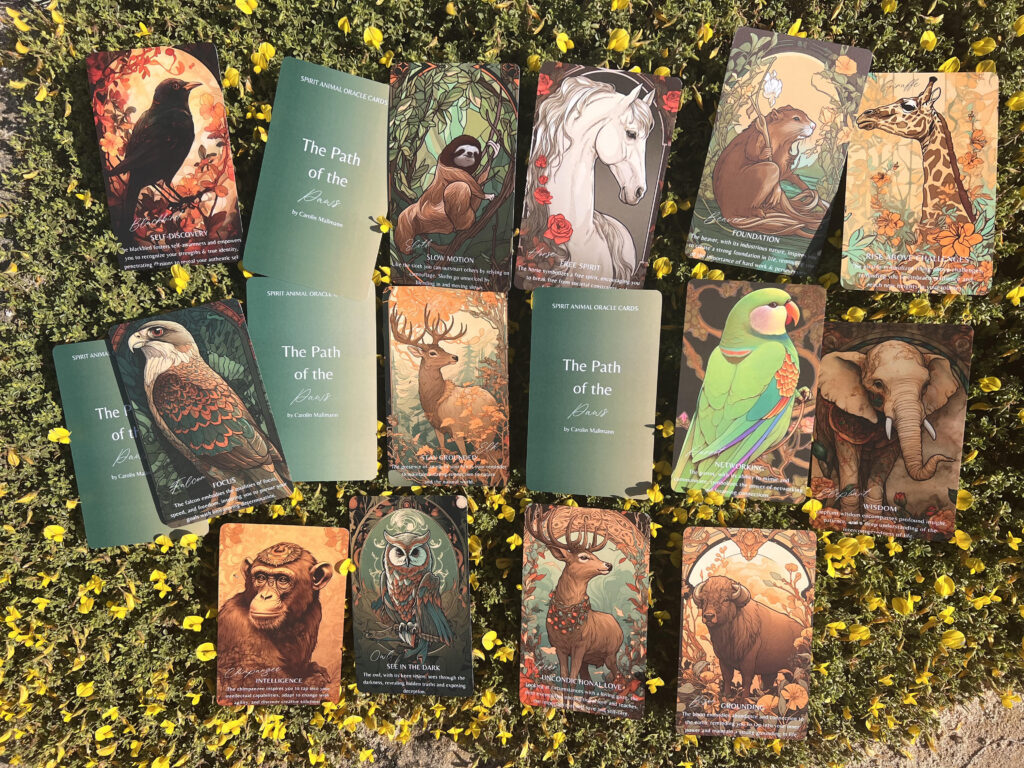
About the Author — Carolin Mallmann
I am Carolin Mallmann, founder of One Shamanism and author of The Path of the Paws. For over two decades I have worked with people as a coach, certified NLP practitioner and shamanic practitioner, guiding thousands of one-to-one sessions and training students internationally in shamanic journeying, spirit animal work and shadow integration. Everything I write here comes from lived practice — my own journeys, my teachers, and the real experiences of the clients I sit with. I do not promise miracles, and shamanic work is not a substitute for medical or psychological treatment. What I can offer is an honest, grounded path back to your own clarity. Read more about my background and practice here.