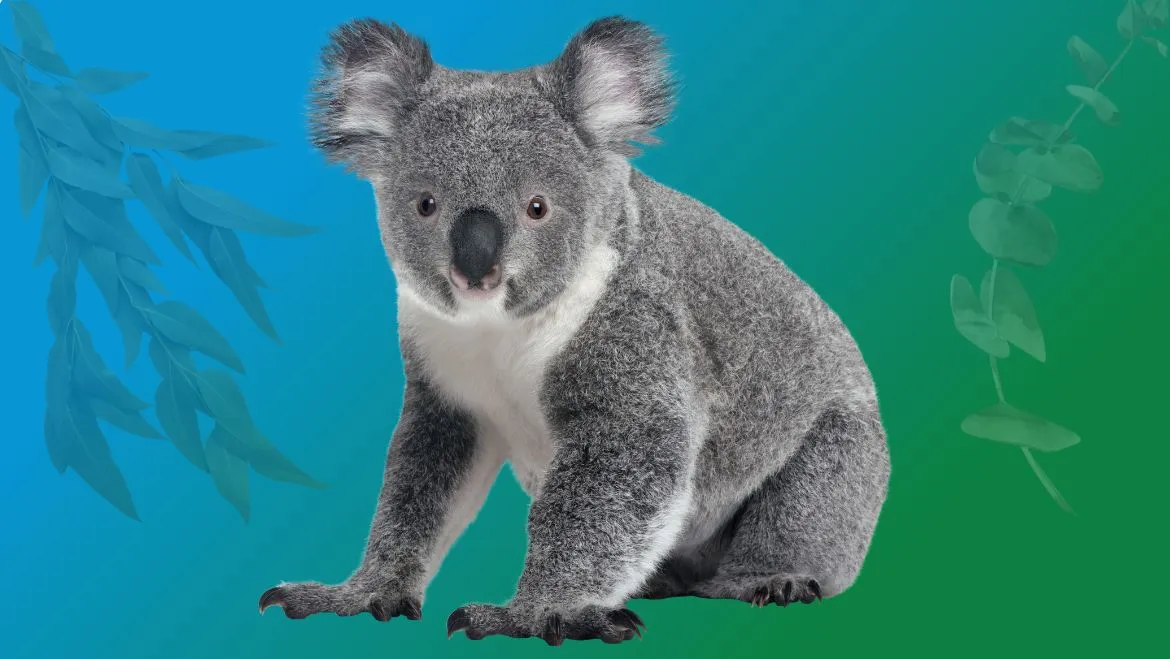
The koala does almost nothing, and it does it with complete authority. On a journey it does not come to meet you — it stays exactly where it is, wedged in the fork of a tree, and waits for you to slow down enough to reach it. There is no urgency in it whatsoever. People describe the same thing again and again: that being near it made their own frantic pace suddenly feel absurd, and a little embarrassing.
This is about the koala spiritual meaning — what it means when this animal keeps appearing in your dreams, your journeys, or your waking life — not about conservation status or diet charts, though both turn out to matter. And it is a guide our culture is almost incapable of hearing correctly, because it looks like laziness. In my practice, the koala arrives for the overworked, the over-stimulated, and the people who have made rest a thing they will get to once everything else is done — which is to say, never.
The Bridge: What Koala Biology Teaches About the Koala Spirit Animal
The koala’s stillness is not idleness — it is a precise, hard-won survival strategy, and every part of its medicine grows out of that.
- It rests up to twenty hours a day — because it must. The koala eats eucalyptus, which is toxic, fibrous and almost devoid of energy. To survive on it at all, the koala has to conserve every calorie and let its gut do slow, demanding work. The koala’s rest is not the absence of effort. It is the effort — the invisible labour of digestion and repair that a fast life never allows.
- It is a specialist, and that is its gift and its danger. The koala has bet everything on one food source and one habitat. When the eucalyptus is there, it thrives with astonishing efficiency. When the forest burns or is cleared, it has nowhere to go. Deep devotion to one source is powerful and precarious in equal measure — hold that; the shadow returns to it.
- It moves only when it means it. A koala is not fast, but it is deliberate — it does not waste a single movement. The medicine is economy: doing less, but doing it with full intention, rather than filling every hour with motion.
- It knows its tree. Koalas are solitary and territorial, each with its home range of specific trees. The medicine is the value of a true sanctuary — a place, a routine, an inner refuge that is unmistakably yours to return to.
When the koala appears as your guide, the question it carries is almost always: where have you mistaken constant motion for worth — and what would you have to feel if you finally stopped?
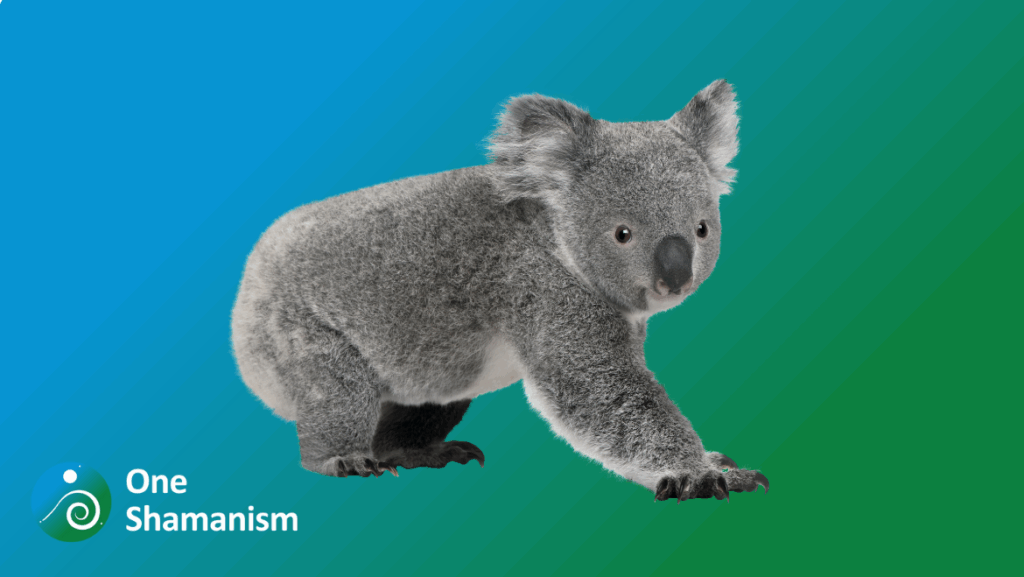
Koala Symbolism and Its Australian Roots
The koala does not have a sprawling, worldwide symbolic history, and I am not going to invent one. Its meaning is rooted in a single continent — Australia — and it is deep rather than wide.
Aboriginal Australia: the animal of the trees
The koala appears in the Dreaming stories of a number of Aboriginal nations, who have lived alongside it for tens of thousands of years. Different peoples hold different stories, and these belong to them — I reference them with respect and without any claim to their ceremonies or authority. What is broadly recognised is that the koala is understood as an animal of the trees and of endurance, tied to the land and to survival through hard, dry seasons. There is a teaching available to anyone in that: the one who endures the drought is not the one who runs fastest, but the one who has learned to need less and to hold still.
The modern symbol: vulnerability and the cost of specialisation
In our own era the koala has become a global emblem of fragility — its dependence on a single, shrinking habitat has made it one of the faces of conservation, and the devastating bushfires of recent years turned it into a symbol of what specialisation costs when the world changes. This is not separate from its spiritual meaning; it is its spiritual meaning, made visible. The koala teaches the beauty of deep focus and the danger of having only one source of nourishment. Both are true at once.
The teaching of the specialist
Read as medicine, the koala is the master of one thing. In a culture that prizes the generalist who juggles everything, it offers a quieter permission: you are allowed to be devoted to a few things and to do them slowly and well. But it pairs that permission with an honest warning — build in at least a second source of life, so that if your one tree falls, you are not left with nowhere to stand.
The Shadow: When Rest Becomes Hiding
Koala medicine has a shadow that is unusually easy to slip into, because it wears the language of self-care.
- Rest that has become withdrawal. This is the distinction the whole animal turns on. Real koala rest is restorative — the body doing its slow, necessary work. The shadow version is retreat from a life that has become too hard to face, dressed up as “taking care of myself.” The test: do you come back down from the tree? If the answer is no, it is not rest. It is hiding.
- Dependence on a single source. The specialist’s shadow. One relationship, one comfort, one substance, one identity carrying the entire weight of your wellbeing. It works — until it doesn’t, and then there is nothing else. If everything good in your life runs through one channel, the koala is naming a real risk.
- Passivity mistaken for peace. Stillness is medicine; inertia is not. The koala conserves energy in order to survive and to move deliberately when it matters. Its shadow is the person who has stopped moving altogether and calls the numbness serenity.
- Isolation as a habitat. Koalas are solitary, and that is healthy for a koala. In a person, chosen solitude can quietly harden into a walled-off life. Sanctuary is meant to restore you for connection, not replace it.
A koala that appears in a dream clinging to a bare or dying tree is one of the clearest images of holding on to a single source that can no longer sustain you. A koala on the ground, exposed and distressed speaks to a sanctuary that has been lost or taken. And a koala sleeping so deeply it cannot be roused asks the honest question underneath this whole guide: is this true rest, or have you gone up the tree so you never have to come back down?
How to Journey to the Koala
Shamanic work is not a substitute for medical or psychological care. If you are new to this, begin with the beginner’s guide to shamanic journeying before attempting the practice below.
- Set a koala-shaped intention. Not “help me relax.” Rather: “Show me where my rest is real, and where it has become a place to hide.” The koala answers that with unusual gentleness.
- Journey to a eucalyptus forest. Tall trees, dry warm air, the particular sharp scent. Do not go looking up and down for the koala. Sit at the base of a tree and let the pace of the place slow you.
- Climb slowly, and settle. The koala will not hurry to you. Match its stillness. Notice how long it takes your nervous system to stop bracing — that number is your diagnosis, and for busy people it is usually alarming.
- Ask it to show you your tree. What is the single source you have been depending on? Is it strong, or is it failing? Do you have a second one? This is the confronting part of the practice.
- Rest with it, and stay past the discomfort. Do nothing, in the journey, for longer than feels acceptable. Let the koala teach you that stillness is not wasted time. When the urge to “get on with it” rises, that urge is exactly the thing to sit through.
- Afterwards, schedule one non-negotiable rest. A real one, in the calendar, defended. And name one second source of nourishment to begin building this month. That pairing is the whole of koala medicine.
Affirmations for Koala Medicine
- “My rest is not a reward I earn. It is the work that keeps me alive.”
- “I can be devoted and still keep more than one source of life.”
- “I go to my sanctuary to be restored — and I come back down.”
Koala Spirit Animal: Questions People Actually Ask
What does it mean when a koala appears in your life?
It is almost always a message about rest and self-care — but the deeper reading is about the difference between restoring yourself and retreating from your life. The koala tends to arrive for people running on empty, and it comes to give them permission to stop, along with an honest check on whether they will ever start again.
Is the koala a good spirit animal to have?
Yes — and a deeply needed one in a culture that treats exhaustion as a virtue. The koala gives permission for slowness, focus and sanctuary. Its only caution is the specialist’s warning: do not let your rest become hiding, and do not stake your whole life on a single source of nourishment.
What does a koala in a dream mean?
Read the tree. A koala resting peacefully in a healthy tree usually confirms that your rest is genuine and restorative. A koala clinging to a bare or dying tree points to a single source you are depending on that can no longer hold you. A koala on the ground, exposed, speaks to a lost sanctuary that needs rebuilding.
Why do I keep dreaming of koalas?
Repeated appearances are usually a blunt message from the body: you need to rest, and you have been overriding it. It can also be a nudge to reconnect with nature or to spend more time in genuine stillness. If the koala keeps returning, treat it as your system insisting on something you have been postponing.
How do I know if the koala is my spirit animal?
Persistence, not preference — whether the image keeps returning uninvited. For a structured way to test the connection rather than guess, work through the A–Z spirit animal guide or sit with the Path of the Paws oracle deck and let the animal find you.
Is the Koala Your Spirit Animal?
Check the boxes that resonate with your spirit and current life journey.
Where is the koala calling you to truly rest — and where has your rest quietly become a place to hide?