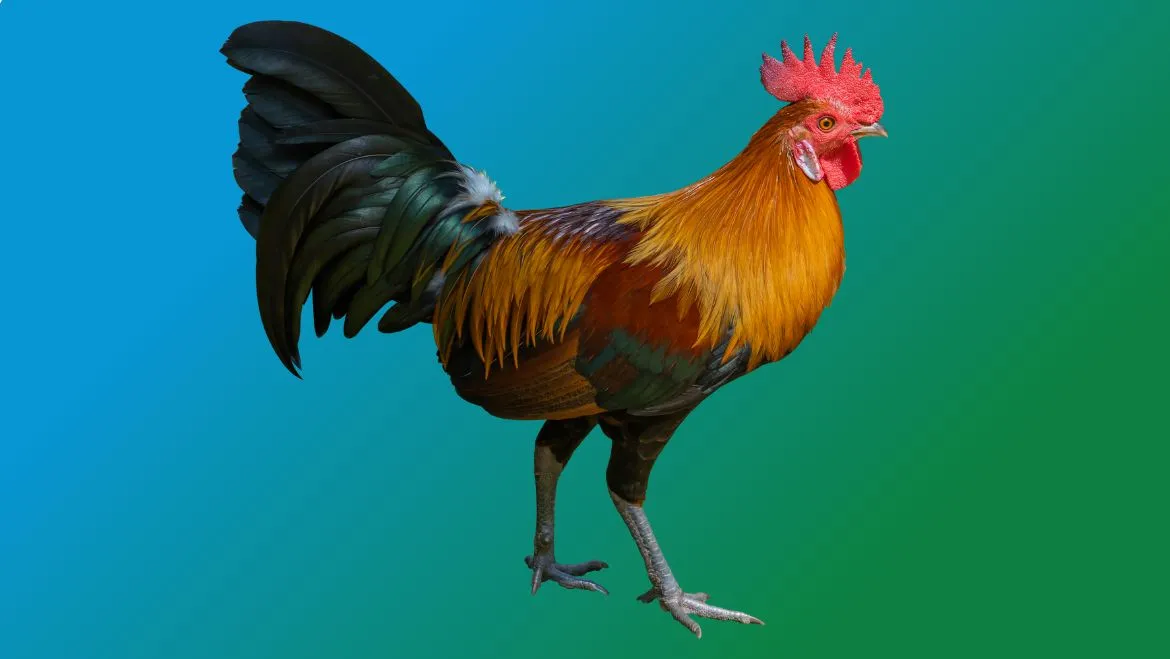
The rooster arrives loud. On a journey it does not creep in at the edge of vision the way many guides do — it lands, plants its feet, and crows, and the sound goes straight through the body before the mind has caught up. What people notice afterwards is almost never the bird’s appearance. It is the nerve of it. The complete absence of apology in a creature announcing itself to a world that did not ask.
This is about the rooster spiritual meaning — what it means when this bird keeps appearing in your dreams, your journeys, or your waking life — not about breeds or egg production. In my practice, the rooster does not arrive for people who are already loud. It arrives, with striking consistency, for people who have swallowed their own voice for years and are being called — sometimes uncomfortably — to use it again.
The Bridge: What the Crow at Dawn Teaches About the Rooster Spirit Animal
Everything this bird has to say is written into the behaviour everyone knows it for — and mostly misreads.
- It crows before the light, not after it. A rooster has an internal clock accurate enough that it begins to call in anticipation of dawn, before the sun is visible. Rooster medicine is not celebrating the change once it is safely here. It is announcing the change while it is still dark — speaking the thing before there is any proof you are right to.
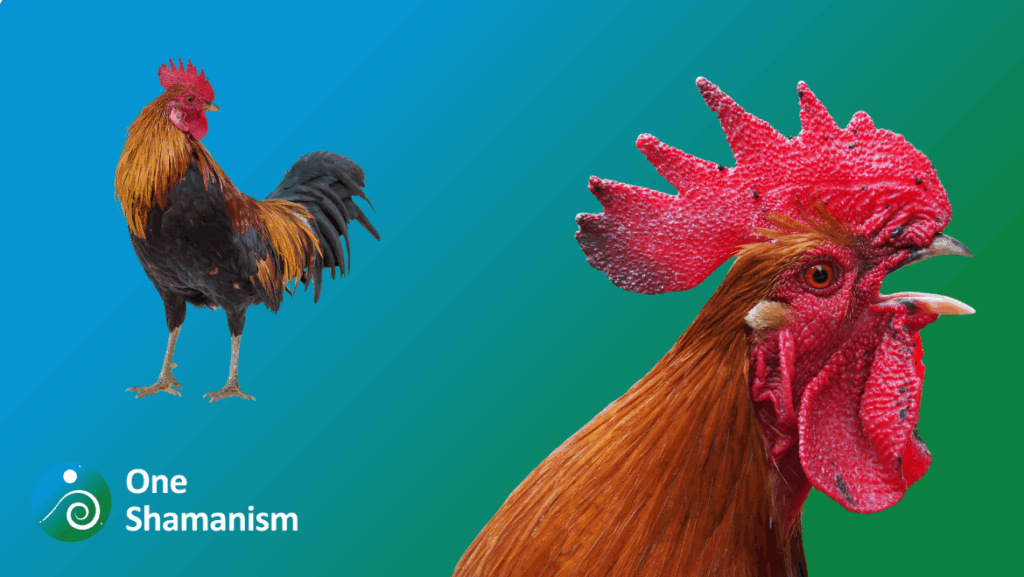
- The comb is honest advertising. That red crest is a real-time signal of health and condition — it cannot easily be faked. The rooster does not perform confidence it does not have; its display is backed by its actual state. The medicine here is the difference between genuine self-possession and bluster, and the bird does not confuse the two.
- Its voice is a protection system. Roosters give distinct alarm calls for different threats — one for a hawk overhead, another for a predator on the ground — and the flock responds accordingly. The crowing is not vanity; it is the flock’s early-warning system. Voice, for the rooster, is how you keep the people you love alive.
- It puts itself between the flock and the danger. A guardian rooster eats last, watches while the others feed, and will place its own body toward a threat. Its assertiveness is not self-serving. It is service that happens to be loud.
When the rooster appears as your guide, the question it carries is almost always: what truth have you been keeping quiet — and who is going unprotected because you will not use your voice?
Rooster Symbolism Across Traditions
The rooster has lived beside human beings for thousands of years, and almost every culture that kept it arrived at the same core meaning: the herald, the watchman, the one who calls the light.
Chinese tradition: the tenth zodiac sign
In the Chinese zodiac the Rooster is one of the twelve signs, associated with honesty, confidence, hard work and a certain flamboyance — and, importantly, with keeping watch and dispelling darkness. In folk practice the rooster was credited with driving off malevolent spirits precisely because its dawn cry ended the reign of the night. You can explore the wider system in the zodiac signs and their spirit animals.
Greek and Roman: the bird of Asclepius
The rooster was sacred to Asclepius, the Greek god of healing — famously, the dying words of Socrates were a request to sacrifice a cock to him, the offering owed for a cure. It was also linked to the dawn and to vigilance, sacred to solar and messenger deities. The thread is consistent: the rooster stands at the boundary between night and day, sickness and healing, and its voice is what carries you across.
Christian and Japanese: conscience and the calling of the light
In the Christian gospels the cock’s crow marks the moment of Peter’s reckoning — the sound that makes a hidden truth impossible to keep denying. That is a precise reading of this bird’s shadow-medicine: the rooster’s call is the voice you cannot silence, the one that names what you already know. In Japanese Shinto tradition, roosters are associated with the sun goddess Amaterasu and are kept freely at some shrines; their crowing is tied to coaxing light back into the world. Wherever it appears, the rooster is the one who calls the dawn rather than merely waiting for it.
The Shadow: When the Crow Becomes Noise
Rooster medicine has a shadow our culture is quick to mock and slow to understand, and it runs in two opposite directions.
- Volume without substance. The comb that advertises a condition the bird does not have. In a person this is confidence performed rather than possessed — the loudest one in the room, crowing to be seen, with nothing underneath the sound. The test is simple and uncomfortable: if no one were listening, would you still say it?
- The swallowed voice. Far more common, in my experience, and the reason the rooster usually comes. Years of not speaking up — in meetings, in relationships, at the dinner table — until silence became the default and the person can no longer find the switch. This is not humility. It is a habit, and the rooster has arrived to argue with it.
- The tyrant of the pecking order. Assertion turned to domination — using your voice to keep everyone else’s down. The guardian rooster protects the flock; the shadow rooster rules it. If your confidence requires other people to be smaller, it is not the medicine.
- Crowing at everything. A rooster that alarms at every shadow exhausts the flock and gets ignored when the real hawk comes. Reactivity dressed as vigilance. Part of this medicine is knowing which threats are worth the call.
A rooster that appears in a dream unable to crow, or with no sound coming out is one of the clearest images of a withheld truth I know — something you are physically holding. A rooster caged or clipped speaks to a situation that is too small for your actual voice. And a rooster attacking or being attacked usually points to a place where assertion and aggression have become tangled, and need separating.
How to Journey to the Rooster
Shamanic work is not a substitute for medical or psychological care. If you are new to this, begin with the beginner’s guide to shamanic journeying before attempting the practice below.
- Set a rooster-shaped intention. Not “give me confidence.” Rather: “Show me the thing I have not been saying, and what it is costing.” This bird responds to that with unusual directness.
- Journey to a farmyard just before dawn. The half-dark, the cold air, the moment before the light. The rooster lives at that threshold, and that is where it will meet you.
- Wait for the crow, and feel where it lands in your body. Rooster medicine is somatic before it is verbal. Notice whether the sound opens your throat and chest, or whether something in you flinches and closes. That flinch is the information.
- Ask it what you are guarding. The rooster watches while the flock feeds. Ask: “What or whom am I meant to be protecting — and where has my silence left them exposed?”
- Ask to be shown your comb. Is your confidence backed by your real condition, or is it display? Is it dimmed and pale, or bright? This image tells you whether your work is to speak up or to quiet down.
- Afterwards, crow once, in waking life. Say the one true thing you have been holding — to the person it belongs to, this week. One sentence. The rooster’s medicine dies in the gap between the journey and the saying.
Affirmations for Rooster Medicine
- “I announce what is true before I have proof I am safe to.”
- “My confidence is backed by my condition. I do not perform what I do not have.”
- “I use my voice to protect what I love, not to drown out the room.”
Rooster Spirit Animal: Questions People Actually Ask
What does it mean when a rooster appears in your life?
It is almost always a message about voice and about timing — specifically, that something needs to be said and a new beginning is closer than you think. The rooster does not arrive to make you generally braver. It arrives pointing at one particular thing you have been keeping quiet, and it is not subtle about it.
Is the rooster a good or bad omen?
Overwhelmingly good — across traditions the rooster is a bringer of dawn, a dispeller of darkness, and a sign of fresh starts. What can make it feel uncomfortable is that it tends to arrive precisely when there is a truth you would rather not speak, and it does not accept avoidance as an answer.
What does a rooster in a dream mean?
Look at its voice. A crowing rooster usually points to something you need to announce or begin. A silent one, or one that cannot crow, points to something you are holding back. A caged rooster speaks to a role or situation too small for you. And a rooster crowing at dawn is one of the most hopeful images this guide offers: a genuinely new chapter is beginning.
Why do I keep seeing or hearing roosters?
Repeated appearances are usually a wake-up call in the most literal sense — a nudge to stop hiding, to let yourself be heard, and to notice that an opportunity or a fresh start is on the horizon. Ask what you have been treating as “not yet” that is in fact already dawning.
How do I know if the rooster is my spirit animal?
Persistence, not preference — whether the image and the sound keep returning without your invitation. For a structured way to test the connection rather than guess, work through the A–Z spirit animal guide or sit with the Path of the Paws oracle deck and let the animal find you.
Is the Rooster Your Spirit Animal?
Check the boxes that resonate with your spirit and current life journey.
In what area of your life is the Rooster spirit calling you to be bold and to “crow” your truth?