The first time the drum takes you somewhere is difficult to forget. One moment you are lying on the floor listening to a steady, monotonous beat; the next, the darkness behind your eyes has become a place — a tunnel, a root, an opening in the ground — and you are moving through it, and something is waiting on the other side. It does not feel like imagining. It feels like arriving. In more than two decades of guiding people through this, I have watched the same startled recognition on hundreds of faces: oh — this is real in a way I was not expecting.
This page explains what shamanic journeying actually is, how it works, and how to take your first one safely. It is one of the oldest spiritual practices on earth, found in some form among peoples across Siberia, the Americas, Africa, Australia and northern Europe — and it is also remarkably learnable. You do not have to belong to a lineage to begin, though it is worth beginning with respect for the ones that carried this practice for tens of thousands of years.
What Is Shamanic Journeying?
Shamanic journeying is the practice of deliberately entering a light altered state of consciousness — usually induced by steady drumming or rattling — in order to travel, in spirit, to non-ordinary reality and meet the helping spirits, guides and power animals who live there. The purpose is not escape. It is to seek guidance, healing, and answers that the ordinary, thinking mind cannot reach on its own, and then to bring what you receive back into everyday life.
What makes it a discipline rather than a daydream is the structure. A journey has a clear intention, a defined entrance, a destination, and a return. You do not wander; you go somewhere specific, ask something specific, and come back. In my experience that structure is exactly what allows the deeper, non-rational intelligence to speak — the same way a riverbank lets water become a current instead of a puddle.
The Three Worlds of the Shamanic Journey
Across many traditions, non-ordinary reality is mapped into three realms. They are not places on a map so much as qualities of experience, but in a journey they are vivid and consistent enough that people who have never spoken to each other describe them in strikingly similar ways.
The Lower World
The Lower World is earthy and primal — ancient forests, deep caves, underground rivers. It is not “lower” in worth; it is the realm of grounding and instinctual wisdom, and it is where most people meet their power animals. You reach it by going down — through the roots of a tree, a cave mouth, a spring. It is the place to go for healing, for the retrieval of lost power, and for the deep, wordless knowing of the body.
The Upper World
The Upper World is celestial and airy — vast skies, cloud, luminous terrain. It is the domain of teachers in human form, of ancestors, and of higher perspective. You reach it by going up — through the branches of a tall tree, through cloud, over an edge. It is the place to go when you need the wide view, the long perspective, or guidance from a wiser vantage point than your own.
The Middle World
The Middle World is the spiritual dimension of our ordinary reality — the same landscape we live in, experienced through a spiritual lens. It is inhabited by the spirits of place, of nature, and of the land. It is the most beautiful and the most complex of the three, and beginners are usually advised to work in the Lower and Upper Worlds first, with guidance, before travelling here.
The Role of Power Animals in Shamanic Journeying
A central part of journeying is the relationship with spirit guides and power animals. These are not decorations of the experience; they are the allies who guide, protect and teach. A power animal offers its particular medicine — the eagle’s clear vision, the bear’s protective strength, the deer’s gentleness — and over time the relationship deepens into something genuinely reciprocal.
You do not choose your power animal. It reveals itself, often surprising you by being an animal you would never have picked. If you want to explore which guides may already be with you, the A–Z spirit animal guide lays out the medicine of each, and the step-by-step guide to finding your spirit animal walks you through meeting one directly.
The Drum: The Shaman’s Horse
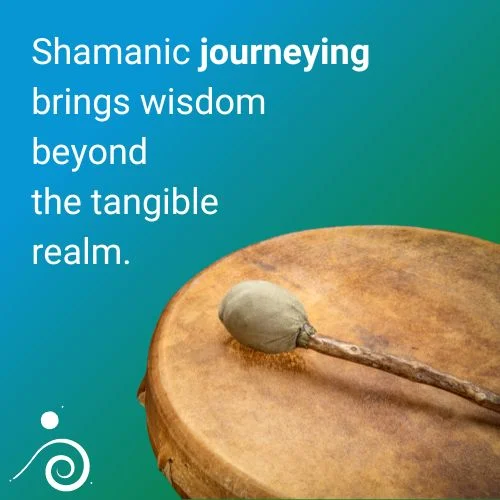
The drum is the engine of the journey. Its steady, monotonous rhythm — traditionally around four to seven beats per second — helps shift the brain toward the theta wave frequencies associated with deep meditation and dreaming, and it carries you across the inner landscape. This is why so many traditions call the drum the “shaman’s horse”: it is what you ride. The beat begins steadily, continues throughout, and then changes — a rapid callback — to bring you home.
You do not need to own a drum to begin. A recording works perfectly well, and the one below is a good place to start.
How to Take Your First Shamanic Journey
Shamanic work is not a substitute for medical or psychological care. If you have a history of trauma or dissociation, begin gently and ideally with an experienced practitioner. For a fuller walkthrough, see the beginner’s guide to shamanic journeying. Here is the shape of a first journey.
- Prepare the space. Twenty to thirty minutes undisturbed, low light, a blanket, and a journal within reach for when you return. Lie down and cover your eyes.
- Set one clear intention. Keep it simple for a first journey: “I ask to travel to the Lower World and meet a power animal that is willing to work with me.” One intention, stated once.
- Find your entrance. Picture a real place in nature you know — a tree, a cave, a spring — and let it become the doorway down into the earth. See it in detail before you begin the drumming.
- Start the drum and descend. When the beat begins, move through your entrance and let yourself travel down. Do not force images; follow whatever appears, even if it seems ordinary at first.
- Meet what comes, and do not chase. When an animal appears, notice whether it presents itself three times or offers itself clearly. Ask, simply: “Are you my power animal?” Let the answer come as feeling as much as words.
- Return with the callback. When the drumbeat quickens, thank whoever you met and travel back the way you came, out through your entrance, into your body. Wiggle your fingers and toes before you open your eyes.
- Write it down immediately. Record what you saw before you interpret it. The integration — turning the journey into something you actually live — is where its value is realised, and it begins with the writing.
Integration: The Part That Actually Matters
A journey is not finished when you open your eyes. The real work is integration — interpreting what you received, and then acting on it in the ordinary world. Guidance you do nothing with fades quickly and stops coming. The practitioners who go deepest are not the ones who have the most dramatic journeys; they are the ones who take the small, concrete actions the journeys ask of them, week after week. That is what turns shamanic journeying from an experience into a practice.
Shamanic Journeying: Questions People Actually Ask
Is shamanic journeying safe?
For most people, a simple Lower or Upper World journey with a clear intention and a proper return is gentle and safe. The safeguards are the structure itself — an intention, an entrance, and a callback that brings you back. That said, it is not a substitute for medical or psychological care, and anyone with a history of trauma, psychosis or dissociation should begin slowly and ideally with an experienced practitioner.
Do I need a drum, or a teacher, to journey?
You need neither to begin. A recording of steady drumming works well, and many people take their first journeys alone with headphones. A teacher becomes valuable as you go deeper — especially for Middle World work and for healing journeys — but the first meeting with a power animal is something you can genuinely do yourself.
What if I do not see anything?
This is the most common worry, and it is almost never a failure. Many people receive journeys as feeling, sound, knowing or bodily sensation rather than clear visual images — and that is completely valid. Do not strain to “see.” Follow whatever you notice, however faint, and trust it. The vividness usually grows with practice, but the guidance is present from the very first journey.
Is shamanic journeying cultural appropriation?
It is a fair and important question. Journeying appears in many cultures, and specific ceremonies, songs and cosmologies belong to specific peoples and are not ours to take. The respectful path is to learn the universal technique — drum, intention, journey — while naming what you do not know, not claiming titles or lineages that are not yours, and honouring the traditions that carried this practice long before it reached you.
How is journeying different from meditation?
Meditation usually cultivates open, choiceless awareness — watching what arises without steering it. Journeying is active and directional: you travel with intention to a destination, interact with what you meet, ask questions, and return with something. Both use a shifted state of consciousness, but journeying is a purposeful expedition rather than a resting in presence.
Shamanic journeying is, in the end, a very old technology for asking the unseen for help — and for listening to the answer with more than the thinking mind. It rewards respect, patience, and the willingness to act on what you are given. Start small, keep a journal, and let the relationship with your guides build the way any real relationship does: slowly, and over time.